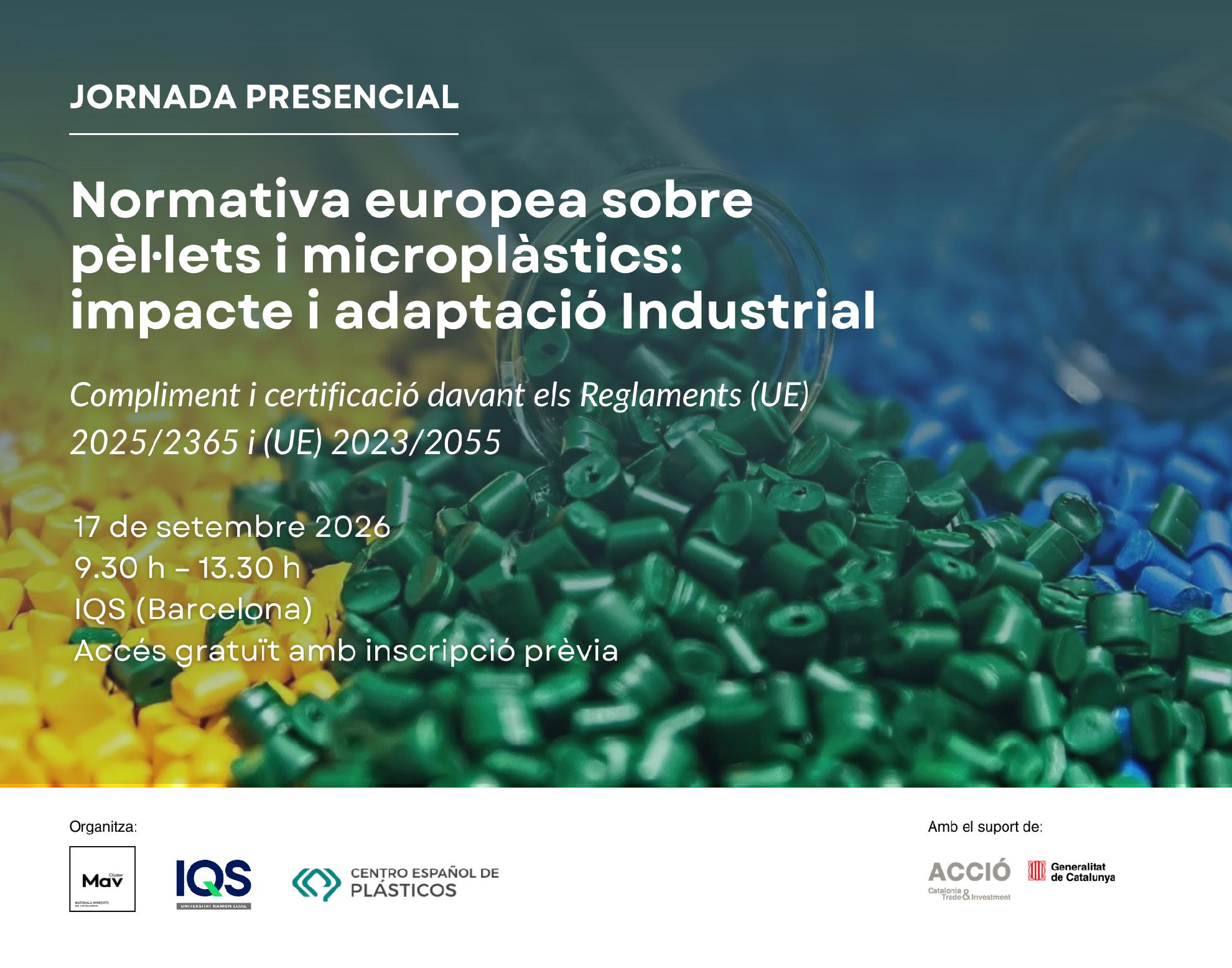
Compliance and certification against Regulations (EU) 2025/2365 and (EU) 2023/2055.
The loss of plastic waste is, according to the European Union, the third largest source of unintentional release of microplastics into the environment. To put a stop to it, Europe has activated a regulatory framework that directly affects the entire plastic value chain: Regulation (EU) 2025/2365, on the prevention of grain losses, and Regulation (EU) 2023/2055, which restricts intentionally added microplastics within REACH. For the first time, preventing pellet leaks, recording the quantities handled and, in many cases, getting certified is no longer a voluntary good practice to become a legal obligation.
For processing companies, manufacturers of raw materials and companies that use plastic materials, this raises very specific questions: to which operators does the regulation apply and from what volume? What is the actual schedule of obligations through 2027 and 2028? What exactly does a risk management plan require? How does a certification like OCS (Operation Clean Sweep) help demonstrate compliance to the administration? And what changes in the design and formulation of materials when certain microplastics are restricted?
This conference was created to answer these questions with rigor and practicality. During one morning, we bring together the key players in the ecosystem—regulatory consultancies, certification bodies, research centers, ecodesign experts and companies that are already implementing these measures—to translate the legal text into executable actions. It's not just about understanding the standard, it's about knowing what needs to be done tomorrow morning in the plant, in the lab and in the quality department.
We combine a technical-legal look at the regulations with a scientific view of the characterization and control of microplastics, and complete it with real industrial cases and eco-design strategies. The goal is for each attendee to leave with a clear map of what the regulations require of them, the tools and certifications available to comply with them and the opportunities that the transition to a circular economy opens up for their business.
Organized jointly by the Institut Químic de Sarrià (IQS), the Centro Español de Plásticos (CEP) and the MAV Cluster, the day is a unique opportunity to anticipate the regulatory change, resolve doubts with the experts and network with professionals in the sector.
Explain the impact of European regulations on pellets and microplastics in the plastics industry.
Analyze the requirements of Regulations (EU) 2025/2365 and (EU) 2023/2055 and their application schedule.
Clarify the current and future obligations of companies according to the role and volume of capital.
Present compliance tools, certifications (such as the OCS) and good management practices.
Share real industrial cases of adaptation and implementation.
Offer a scientific vision on characterization, control and eco-design applied to microplastics.
The conference is aimed at plastic processing companies, manufacturers of raw materials and companies that use plastic materials. In particular, to those responsible for quality, sustainability, environment, regulatory compliance, R&D and industrial management who need to anticipate the new regulatory obligations.
09:00 – Accreditation and reception of attendees.
09:30 – Institutional welcome. IQS Tech Transfer.
10:00 – Block 1: Regulatory context / the legal framework and the management of grain (pellets).
The current problem of microplastics in the industrial sector. Clara Comas, Project Manager of Good Karma Projects.
Technical-legal analysis of regulations (EU) 2023/2055 and 2025/2365. Direct implications for transformers and manufacturers. Ma. Rosa Cirera, Ramboll senior consultant.
The OCS (Ocean Clean Sweep) certificate as a regulatory compliance tool. How certification helps to meet EU fat loss requirements. Ángel Méndez, commercial director of Kiwa.
Industrial success case: implementation of OCS in a grain production plant. Hands-on experience, challenges and benefits from a leading manufacturer.
10:50 – Question time
11:05 – Coffee break
11:35 – Block 2: science, characterization and eco-design.
Methods of analysis and control of polymers in the laboratory. Núria Agulló, Materials Engineering Group of the IQS Tech Transfer.
Problems and monitoring of microplastics in the industrial ecosystem. Ethel Eljarrat, director of IDAEA-CSIC.
Ecodesign and circularity: adapting the catalog of materials to EU restrictions. Mireia Andreu, senior consultant in circular economy and ecodesign at inédit.
12:30 – Block 3: round table: roadmap for the plastic sector 2026-2030.
Ma. Rosa Cirera, Ramboll senior consultant.
Ángel Méndez, commercial director of Kiwa.
Ethel Eljarrat, director of IDAEA-CSIC.
Mireia Andreu, senior consultant in circular economy and ecodesign at inédit.
Antoni Prunera, head of business development, R&D and intellectual property at Elix Polymers.
Moderator: Carme Balcells, responsible for innovation projects and technical advice at the Centro Español de Plásticos (CEP).
13:15 – Conclusions and closure.
13:30 – End of the day.
The session is free and open to everyone with prior registration through this link.
The day will take place at the Chemical Institute of Sarrià (IQS) (Via Augusta, 390, Barcelona).




_20210324092110.png)